

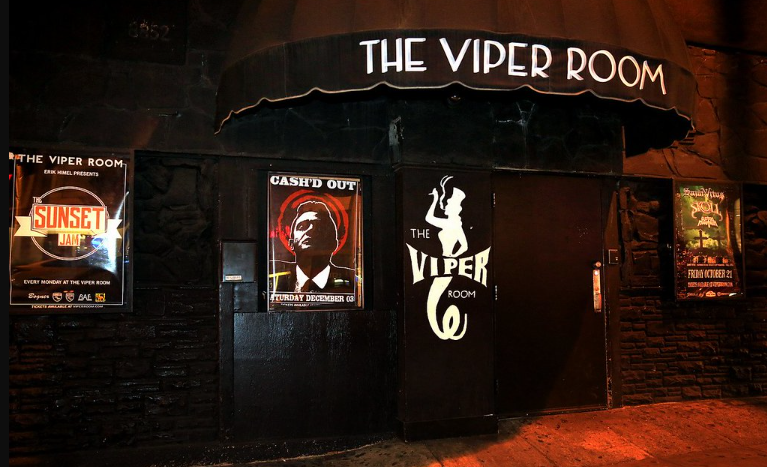
Thirty-two years ago, on Halloween night in 1993, Hollywood lost one of its brightest young stars. River Phoenix, the 23-year-old actor celebrated for films like Stand By Me and My Own Private Idaho, collapsed outside the Viper Room—a Sunset Strip nightclub owned by Johnny Depp—and died from a fatal drug overdose and heart failure.
Since that night, the Viper Room has carried a reputation that feels straight out of a rock-and-roll ghost story. Its history is filled with tragedy, addiction, and mystery—leading many to believe the club is cursed.
In August 1993, Depp and his 21 Jump Street co-star Sal Jenco opened the Viper Room on the legendary Sunset Boulevard. The building had lived many lives before—once a grocery store, later a string of different nightclubs—but under Depp’s ownership, it quickly became one of Hollywood’s hottest hangouts.
It attracted the young and famous: actors, musicians, and models who embodied the wild, edgy spirit of the ‘90s. But less than three months after opening, River Phoenix’s shocking death outside its doors cast a permanent shadow over the club’s glittering reputation.
On October 30, 1993, River arrived at the club with his girlfriend, his brother Joaquin, and his sister Rain. He was supposed to perform with Depp’s band, P, but during the night he began to feel unwell. Musician Bob Forrest later recalled that River thought he might be overdosing but seemed coherent enough that few realized how serious it was. Moments later, chaos erupted as River collapsed on the sidewalk.
Joaquin called 911 while Rain tried desperately to revive him. Paramedics rushed River to Cedars-Sinai Medical Center, but he was pronounced dead before 2 a.m. Toxicology reports showed lethal amounts of heroin and cocaine, along with traces of other substances.
Despite the tragedy, the Viper Room remained a magnet for Hollywood’s elite—and its darker undercurrents persisted. Depp’s then-girlfriend, supermodel Kate Moss, was part of the club’s “heroin chic” scene. In 1995, Australian actor Jason Donovan collapsed from a cocaine overdose during Moss’s 21st birthday celebration. He survived, but his near-death experience added to the club’s notorious reputation.
That same year, Courtney Love also overdosed outside the Viper Room. Years later, during Depp’s legal battle with Amber Heard, Love revealed in an Instagram video that Depp had performed CPR on her that night, saving her life.
The eerie coincidences didn’t stop there. In November 1997, INXS frontman Michael Hutchence played his final live show at the Viper Room. Just days later, he was found dead in his hotel room in Sydney, Australia.
Then came another mystery. In 1999, Depp’s business partner Anthony Fox sued him, accusing the actor of financial misconduct. But in December 2001—just before he was set to testify—Fox disappeared without a trace. His car was later found abandoned, but Fox himself was never seen again. Conspiracy theories swirled, though no evidence ever linked Depp to his disappearance.
By 2004, Johnny Depp sold his stake in the club, but the stories surrounding the Viper Room continued to grow. Between the overdoses, the disappearances, and the endless rumors, the venue became more than just a nightclub—it became a symbol of Hollywood’s dark side, where fame, excess, and tragedy collide.
Today, the Viper Room remains one of Los Angeles’s most infamous landmarks. And for those who remember that Halloween night in 1993, its name still conjures the haunting memory of River Phoenix—the brilliant star who burned too bright, too fast.