

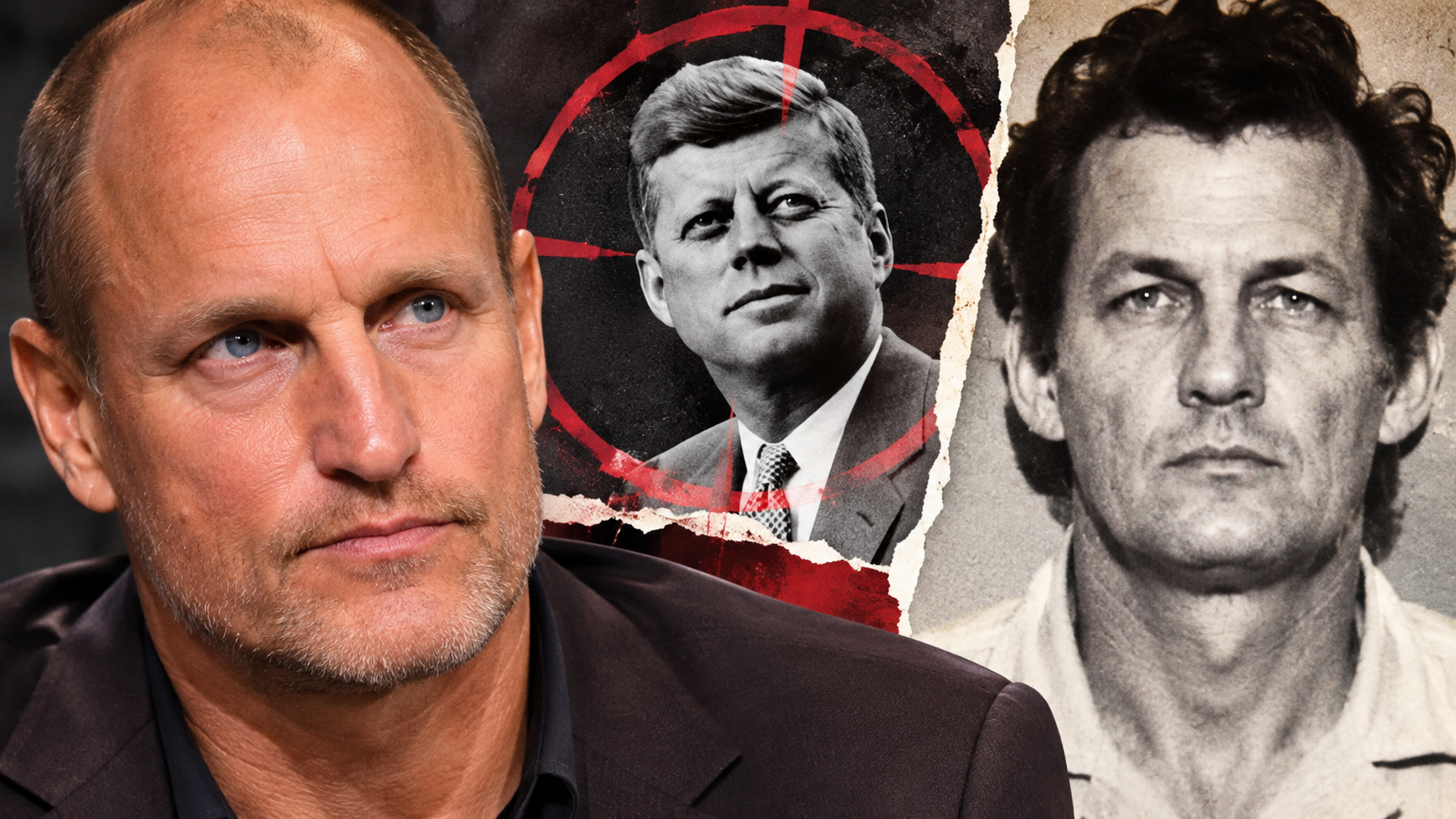
Hollywood star Woody Harrelson has one of the most disturbing family histories in show business, involving a convicted hitman, the assassination of a federal judge and a shocking claim about one of America’s most infamous murders.
Long before Harrelson became a household name on Cheers and starred in blockbuster films, his father, Charles Harrelson, was making headlines for an entirely different reason.
The notorious contract killer, convicted of two murders, once claimed he was responsible for assassinating President John F. Kennedy.
The bombshell confession came during a bizarre six-hour police standoff in Texas in September 1980, when authorities cornered Charles after he had skipped a court appearance.
According to historical accounts, Charles was under the influence of cocaine and threatening to take his own life when he made the astonishing declaration.
He reportedly admitted to killing both Kennedy and federal Judge John H. Wood Jr., whose assassination had stunned the nation just a year earlier.
The statement immediately raised questions about whether the convicted killer knew something about the November 22, 1963, assassination in Dallas that investigators had missed.
But the story took another strange turn when Charles later admitted he had made the JFK claim while in a severely impaired state.
Speaking about the confession afterward, he suggested his statements reflected his mental condition during the confrontation.
He also described the dramatic claims as “an effort to elongate my life.”
There has never been credible evidence establishing Charles Harrelson’s involvement in Kennedy’s assassination, and he was never charged in connection with the president’s death.
Nevertheless, his confession became a favorite subject among conspiracy theorists, especially after some researchers suggested he resembled one of three mysterious men photographed in police custody near Dealey Plaza shortly after Kennedy was killed.
The men became known as the “three tramps,” and speculation about their identities continued for years.
However, the Texas State Historical Association reports that Charles was eventually ruled out as one of the men after Dallas police identified them.
While the Kennedy confession remained unsubstantiated, Charles’s involvement in another high-profile killing was proven in court.
On May 29, 1979, Judge Wood was fatally shot outside his San Antonio home in an assassination that sent shock waves through the federal justice system.
The judge, nicknamed “Maximum John” because of his reputation for imposing tough sentences on drug offenders, had become a feared figure among criminals.
Prosecutors alleged that drug trafficker Jamiel “Jimmy” Chagra arranged a $250,000 contract to have the judge killed before a major criminal proceeding.
Charles was eventually convicted of Wood’s murder in December 1982 and sentenced to two life terms plus five years. Chagra, however, was acquitted of the murder-for-hire charge in a separate trial.
It wasn’t Charles’s first murder conviction.
He had previously been found guilty in the killing of Texas grain dealer Sam Degelia Jr. and sentenced to 15 years in prison. He was also accused in a separate killing but was not convicted in that case.
For Woody Harrelson, the horrifying crimes became part of a complicated family legacy he could never completely escape.
The future Hollywood star was just a child when his father largely disappeared from his life, leaving his mother to raise Woody and his two brothers.
Despite their troubled relationship, Woody later attempted to help his father challenge his conviction in the federal judge’s murder.
The actor has publicly questioned whether Charles received a fair trial, even suggesting he believed his father was innocent of that particular killing.
In a 2015 interview with The Guardian, Woody acknowledged that his father had spent much of his life behind bars, explaining that he had learned to live with his difficult family history.
Charles died of a heart attack in March 2007 at age 69 while serving his sentence at a maximum-security federal prison in Colorado.
His death closed the chapter on a criminal career that had involved murder-for-hire, a massive federal investigation and one of the strangest claims ever connected to the Kennedy assassination.
For Woody Harrelson, whose Hollywood career has included playing dangerous and deeply troubled characters, the reality of his father’s life remains more unsettling than almost anything depicted on screen.
And more than six decades after Kennedy’s assassination, Charles Harrelson’s extraordinary confession remains a chilling footnote to one of America’s most enduring mysteries.