

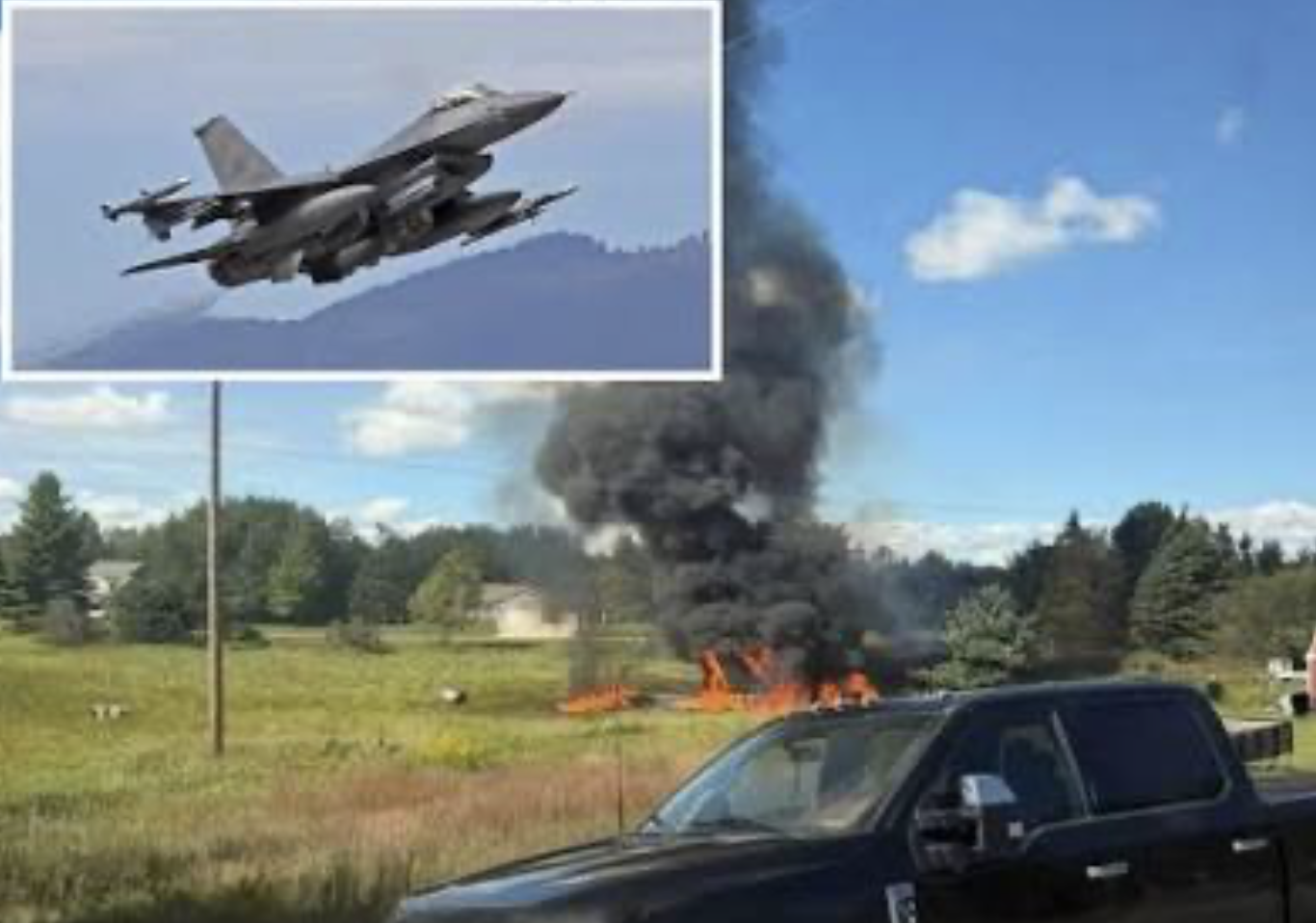
An F-16 fighter jet from the Texas Air National Guard crashed in northern Michigan Thursday during a training mission, sending a towering plume of smoke into the sky and forcing nearby residents to evacuate.
The pilot managed to eject before the jet slammed into the ground in Blair Township, south of Traverse City, according to the 149th Fighter Wing.
The pilot was recovered and taken to a local hospital for treatment. Military officials said the pilot was in stable condition, while Michigan State Police reported no other injuries.
The dramatic crash happened while the F-16 was taking part in a routine training mission from the Alpena Combat Readiness Training Center, where members of the Texas-based 149th Fighter Wing have been participating in a large training exercise.
Radio traffic from the moments before the crash offers an early clue about what may have gone wrong — but investigators have not yet determined the official cause.
In air-traffic-control audio reported by The War Zone, a pilot using the call sign “Buck 11” tells controllers his wingman may have hit a bird.
“We have a possible mayday,” the pilot says, adding that his wingman “may have taken a bird.”
The pilot later warns controllers that the stricken F-16 may not make it to an airport.
“Alert emergency services,” he says before adding that the other pilot was “gonna have to get out.”
The radio exchange strongly suggests the pilots were dealing with a sudden airborne emergency, but neither the 149th Fighter Wing nor investigators have confirmed that a bird strike caused the crash. The military says the incident remains under investigation.
The aircraft went down near County Road 633 and Blair Townhall Road in Grand Traverse County.
Witnesses described hearing a violent impact before seeing thick black smoke pouring into the sky.
Local resident Wendy Sobeck told the Associated Press that she and her husband initially thought there had been a car accident near their home. When her husband went to investigate, he could see aircraft debris scattered in a field as additional explosions continued.
Emergency officials initially ordered people along part of County Road 633 to shelter indoors, close their windows and vents and stay away from the crash scene.
Authorities later expanded the response and ordered residents within roughly one mile of the wreck to evacuate away from the area around County Road 633 and Jefferson Place.
The precautions were particularly important because F-16s carry hydrazine as part of their emergency power system.
Air Force technical guidance describes hydrazine as a highly toxic chemical used by the F-16’s Emergency Power Unit, which can provide emergency electrical and hydraulic power if the aircraft suffers an engine or primary power failure.
That does not mean hydrazine caused Thursday’s crash. Instead, its presence aboard the aircraft helps explain why emergency crews take special hazardous-material precautions around a damaged F-16.
The fighter was assigned to the 149th Fighter Wing, headquartered at Joint Base San Antonio-Lackland in Texas.
Just days before the crash, the unit had arrived in Michigan for Operation Northern Cactus, an annual exercise designed to test how well the wing can deploy aircraft, personnel and equipment away from its home base and continue operating in an unfamiliar environment.
Official Defense Department imagery published this week shows the wing’s F-16s conducting flight operations at the Alpena Combat Readiness Training Center on Sept. 14.
See official Air National Guard photos from Operation Northern Cactus
The Defense Visual Information Distribution Service said the exercise places the Texas unit in an “austere environment” to simulate a real-world deployment.
The aircraft involved in Thursday’s crash had also been operating during a particularly visible week for the visiting unit.
F-16s from the 149th Fighter Wing had been scheduled to fly over Alpena High School’s football game against Gaylord Friday night as part of the school’s Valor Game honoring veterans, first responders and missing service members.
It was not immediately clear Thursday evening whether that flyover would still take place.
The F-16 Fighting Falcon is a single-engine, multirole fighter that has served with the U.S. military for decades. According to the Air Force, the jet can reach approximately 1,500 mph at altitude and is designed for both air-to-air and air-to-ground missions.
Investigators will now work to determine exactly what happened in the seconds before the aircraft went down.
For now, the military has confirmed only that the F-16 experienced an incident during the training mission, the pilot successfully ejected and the crash remains under investigation.
The wingman’s reference to a possible bird strike is an important piece of evidence — but until the investigation is complete, it remains an early theory rather than an established cause.