

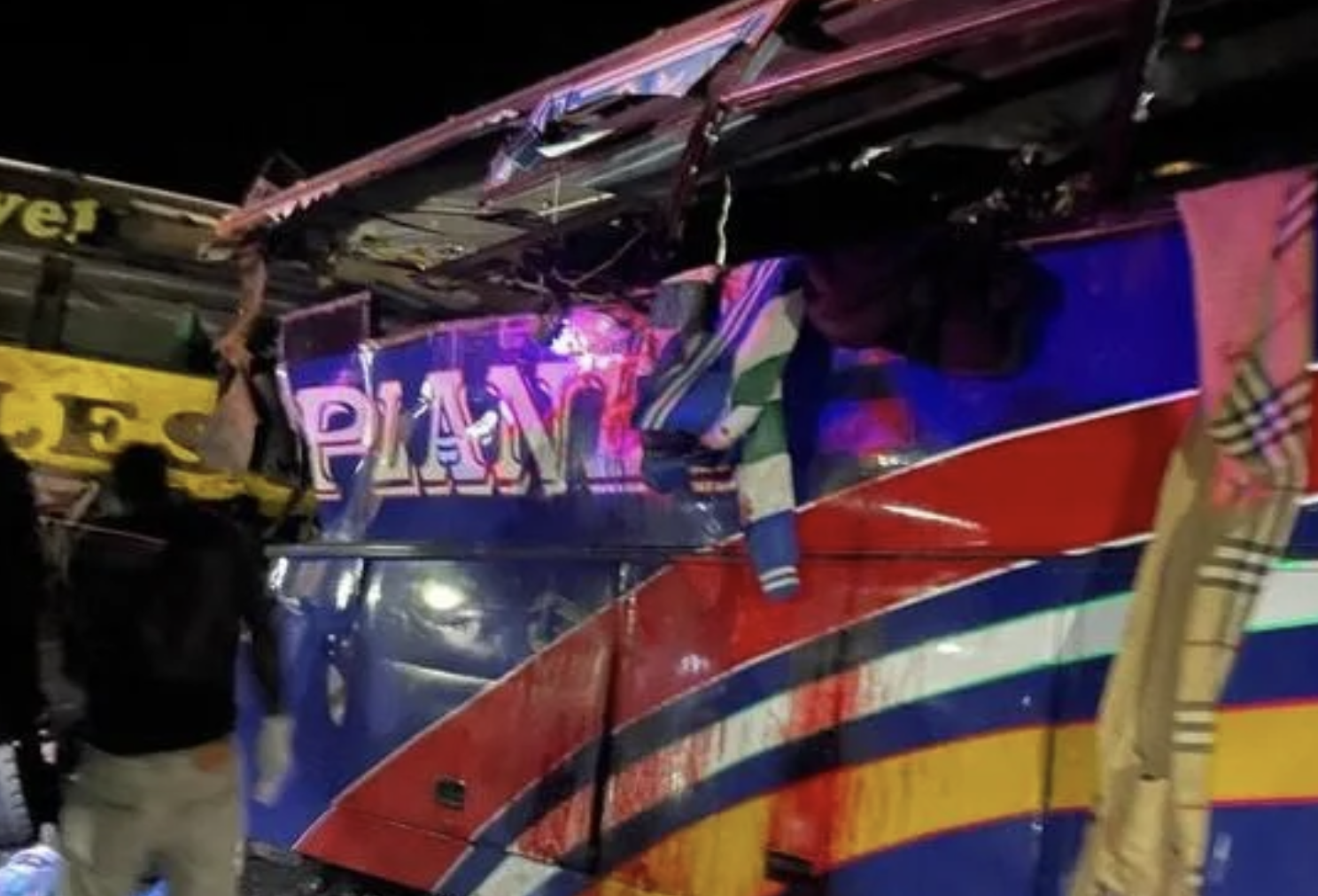
At least 63 people were killed in a catastrophic highway collision in Uganda early Wednesday morning, as two speeding buses smashed head-on during a deadly overtaking attempt that left vehicles mangled and bodies scattered across the road.
The crash occurred just after midnight on October 22 along the busy Kampala–Gulu Highway, a notorious route linking the capital to northern Uganda. Police said both buses were trying to overtake slower vehicles when they collided near Kitaleba Village, creating what witnesses described as a “scene of utter destruction.”
“Everything happened in seconds,” said eyewitness Peter Owor, a truck driver who had been trailing behind one of the buses. “I heard a massive explosion, and when the dust cleared, people were screaming from everywhere. The buses were crushed together like tin cans.”
Authorities confirmed that four vehicles were involved in total — two buses, a car, and a truck — after the violent impact triggered a deadly chain reaction that left several vehicles overturned on the roadside.
According to preliminary findings from the Uganda Police Force, the Isuzu bus traveling north from Kampala tried to overtake a lorry, while the other bus heading south attempted to pass a car at the same time. The two vehicles collided head-on at high speed.
“One of the drivers tried to swerve, but it was too late,” police spokesperson Patrick Onyango told reporters at the crash site. “The force of impact caused both buses to spin, striking nearby vehicles and overturning several times. It was a horrific scene.”
Photos from the scene show twisted metal and shattered glass scattered across the highway, with emergency crews pulling bodies from the wreckage as dawn broke.
Police said all 63 victims were passengers in the vehicles involved, and “several others” were injured — some critically. Survivors were rushed to Kiryandongo Hospital and nearby clinics for emergency treatment.
Local radio station Mega FM reported that the buses had been carrying both long-distance travelers and students returning to school after holidays. “Many families are still waiting for word on their loved ones,” one broadcaster said.
Bodies of the deceased were transported to Kiryandongo Hospital mortuary for post-mortem examinations and identification.
Uganda’s highways have long been plagued by reckless driving and poor road conditions. In 2024 alone, government data recorded over 22,000 traffic crashes nationwide — many linked to speeding and illegal overtaking.
“This was preventable,” said road safety advocate Sarah Namutebi of the Uganda National Road Users Association. “We keep warning drivers about overtaking on blind corners and narrow roads, but the culture of speed and impatience keeps killing people.”
Police renewed calls for drivers to “exercise maximum caution,” urging motorists to avoid overtaking on narrow or busy stretches.
By Wednesday afternoon, rescue crews were still working to clear the wreckage, as families gathered at hospitals to identify loved ones.
“We extend our deepest condolences to all families affected,” the police statement read. “May the souls of the departed rest in peace, and may the injured recover quickly.”
As Uganda reels from one of its deadliest crashes in years, local media have begun calling for stricter transport enforcement and improved lighting on rural highways — before another midnight run turns into a national tragedy.